The rolling steppe of Central Asia makes way to stark desert; across this vast landscape, nomadic ger camps are peppered, camels and goats are herded on horseback, fermented mare’s milk is the tipple of choice, dunes sing and the first intact dinosaur eggs were found. Genghis Khan went forth from here to conquer the biggest land empire in history and, to this day, Buddhist and Animist traditions mix. In July, all over the country, people unite to compete in wrestling, archery, horse racing and ankle-bone flicking during the Naadam Festival but traditions can be witnessed throughout the year. We travel through steppe, mountain and the Gobi Desert exploring the nature and culture of this fascinating, yet little known, country.
This itinerary is for the departure starting in Ulaanbaatar on 30 June 2027. For an alternative itinerary that departs on 9 July 2027, click here.
Activity Areas
Cultural Wonders
Culture
Festival and Events Holidays
Festival Holidays
Natural Wonders
Region & Country & City
Asia: Gobi Desert, Mongolia
Included in the Price
All accommodation: 6 Comfort nights (hotels), 8 Simple nights (traditional nomadic ger camps) - All breakfasts, lunch and dinners - Immersive itinerary with all transport and listed activities - Expert tour leader to enhance your adventure - Group arrival and departure transfers available
Not Included In The Price
Request a single room if required, purchase travel insurance and arrange any visas and vaccinations. We offer Eagle Festival and non-festival departures - speak to your sales representative for more information.
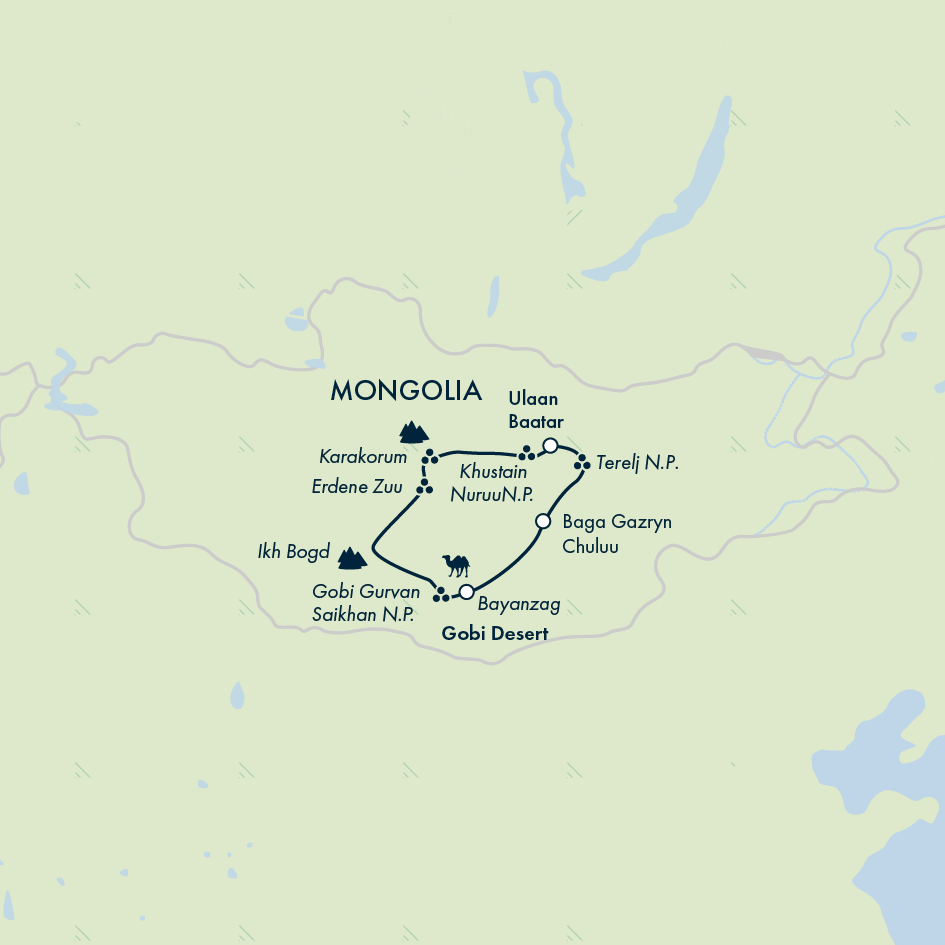
Map
Itinerary
Day 1 Adventure starts in Ulaanbaatar
Our adventure starts in Ulaanbaatar, Mongolia’s capital city. There are no activities planned for today to allow for different arrival times. If you have time to explore some of the sites we recommend visiting Sukhbaatar Square, the National Museum and the landmark State Department Store.
Around 6pm, say hello to your tour leader and fellow travellers, when we gather as a group for the first time to get to know each other and learn more about the adventures ahead. Your tour leader then ensures a big welcome by arranging a group dinner at a nearby restaurant.
Want more time in Ulaanbaatar? Secure pre-tour hotel nights through your sales representative.
Day 2 To Karakorum • Track takhi, the last truly wild horses in the world • Visit Erdene Zuu Monastery
Journey west across the steppe to Karakorum, the 13th-century capital of the Mongol Empire, founded under Ogedei Khan.
En route, we detour to Khustain Nuruu National Park, one of Mongolia’s great conservation success stories. The park is best known for the reintroduction of the takhi (Przewalski’s horse). Once extinct in the wild, the species now roams freely here again thanks to decades of conservation work led by Mongolian and international organisations.
After visiting the information centre, we take a guided hike through the steppe in search of the horses. The contrast of Bactrian camels crossing the dunes while horses graze nearby captures the unique geography of central Mongolia, where desert and grassland meet.
After arrival, we visit Erdene Zuu Monastery, founded in 1586 and considered Mongolia’s earliest surviving Buddhist monastery. Much was destroyed during the anti-religious purges of the 1930s, but the enclosing wall, 108 stupas and several temples remain – a powerful reminder of both Mongolia’s Buddhist heritage and its turbulent 20th-century history.
We also visit the Karakorum Museum for more context on the former capital, before continuing to our camp in the late afternoon.
Total drive time: six to seven hours
Day 3 Continue along the edge of the Gobi Desert to Arvaikheer
Follow the northern fringe of the Gobi Desert to Arvaikheer, the capital of the Ovorkhangai Province
Along the way, we stop at Shankh Monastery, one of the oldest monasteries in Mongolia and once associated with Zanabazar, the revered Buddhist scholar, artist and spiritual leader often considered the father of Mongolian Buddhism. The monastery remains an active religious site, and our tour leader helps bring its history and symbolism into context.
Arriving in Arvaikheer in the afternoon, we visit the local museum, where exhibits include ancient stone figures, archaeological finds and Turkic inscriptions that trace the deep human history of the Mongolian steppe. Depending on timing, we may also stop at the local market for a glimpse into everyday provincial life.
Total drive time: three hours
Day 4 Drive into the remote landscapes of Bayan Gobi
Today is the longest drive of the trip, but also one of the most rewarding as we leave the main tourist route behind and enter the more remote reaches of the Gobi.
After breakfast, the paved road soon disappears and the scenery steadily changes. Vast gravel plains, dry riverbeds and distant mountain ranges dominate the horizon as we travel deeper into the desert. In the distance, the Ikh Bogd Mountain rises above the landscape, the highest peak in the Gobi Altai range and an important landmark for local herding communities.
The journey takes approximately nine hours including stops, giving us time to appreciate the sheer scale and isolation of Mongolia’s southern wilderness. Encounters with other vehicles are rare, and the silence of the open steppe becomes part of the experience itself.
Arrive at our remote ger camp by evening for a night surrounded by desert landscapes and uninterrupted skies.
Total drive time: six to seven hours
Day 5 Cross desert passes • Visit the White Cave
Continue through classic Gobi scenery, where rocky plains, isolated outcrops and pockets of sand stretch across the Khatan Suudal Steppe.
After crossing a desert pass, we visit the White Cave, known for its pale quartz-rich rock formations and archaeological significance. The surrounding landscape feels increasingly remote, with little beyond open steppe and distant mountain silhouettes.
We stop for a picnic lunch overlooking Arts Bogd Mountain before continuing towards the Khongoriin Els dunes. The gradual arrival of the dunes is particularly memorable, their vast ridges rising unexpectedly from the flat desert terrain.
Reach our ger camp in the late afternoon.
Total drive time: fix to six hours
Day 6 Experience the Singing Dunes • Meet camel herders to learn about their nomadic life
Spend the day among the Khongoriin Els, the largest dune system in Mongolia, stretching approximately 125mi (200km) across the South Gobi.
Some dunes reach heights of almost 985ft (300m), and when the wind conditions are right, the shifting sand creates the low vibrating sound that gives them the nickname Singing Dunes.
Later, we visit a local camel-herding family to learn more about nomadic life in the desert. The South Gobi is home to around 100,000 Bactrian camels, still widely used to transport goods and gers across remote areas in one of the world’s harshest environments.
Total drive time: 30 minutes
Day 7 Hike into Yolyn Am canyon in Gobi Gurvansaikhan National Park
Drive through Gobi Gurvansaikhan National Park, whose name translates as Three Beauties of the Gobi, referring to the mountain range that dominates the region.
The landscapes here are remarkably varied, shifting between rocky desert, sand plains, narrow ravines and isolated oases. Our main destination is Yolyn Am, also known as Vulture’s Mouth, a canyon so deep and narrow that winter ice can remain on the valley floor even in the height of summer.
We visit the local museum before walking into the canyon itself. The area supports a surprising range of wildlife, including ibex, lammergeiers, argali sheep and, more rarely, snow leopards. Our tour leader helps identify the signs of life in what initially appears to be a harsh and empty environment.
Later, transfer to a nearby ger camp.
Total drive time: four hours
Day 8 Hike among the Flaming Cliffs of Bayanzag
Enjoy a slower-paced day with time to relax at camp before visiting one of the most important palaeontological sites in Mongolia.
Either in the morning or afternoon, we drive approximately 43mi (70km) to Bayanzag, better known as the Flaming Cliffs. The name comes from the deep red-orange colour of the sandstone.
The cliffs became internationally famous in the 1920s, when American explorer Roy Chapman Andrews uncovered some of the world’s first dinosaur eggs here. Even today, fossil fragments can occasionally be spotted on the ground. During our hike through the area, our tour leader explains the significance of the discoveries and how they changed scientific understanding of dinosaurs forever.
Return to camp later in the day.
Total drive time: three hours
Day 9 Discover the dramatic rocks of Baga Gazryn Chuluu
Begin the journey back towards Ulaanbaatar, staying overnight by the dramatic granite formations of Baga Gazryn Chuluu.
Rising abruptly from the steppe, these weathered rock formations have long been associated with Buddhist pilgrimage and local legends. We visit the ruins of Lovonchombo Monastery, once an important religious centre hidden among the rocks, before continuing to a nearby natural spring believed by local people to have healing properties for the eyes.
The surrounding landscape is particularly atmospheric in the evening light, when the granite formations cast long shadows across the grasslands. Tonight is our final stay in a traditional ger camp.
Total drive time: six to seven hours
Day 10 Walk to Aryabala Temple in Terelj National Park
Leave the grasslands behind, driving into Terelj National Park, one of Mongolia’s most accessible protected areas, where granite rock formations, forested valleys and mountain meadows create a markedly different landscape to the open steppe. Depending on the season, the meadows are dotted with wildflowers, including edelweiss.
In the afternoon, we walk to the Aryabala Temple, a Tibetan Buddhist meditation centre set on a hillside overlooking the park. The path climbs steadily via a series of steps, passing boards inscribed with Buddhist teachings and reflections. The elevated position of the temple provides a fitting setting for contemplation and wide-ranging views across the surrounding valleys.
Total drive time: six to seven hours
Day 11 Visit the Genghis Khan Statue Complex • Return to Ulaanbaatar
Begin the journey back to Ulaanbaatar, pausing at the Genghis Khan Statue Complex at Tsonjin Boldog. Standing 130ft (40m) high atop a 33ft (10m) visitor centre, it is among the largest equestrian statues in the world and commemorates the founder of the Mongol Empire. Those who wish can ascend through the structure to a viewing platform positioned on the horse’s head, offering a closer look at the monument and the surrounding landscape.
After lunch near the complex, we continue to Ulaanbaatar. This evening, there is the option to attend a traditional music and dance performance at the National Academic Drama Theatre (approximately US$10), showcasing throat singing, folk music and dance styles from across Mongolia.
Total drive time: two hours
Day 12 Ulaanbaatar and Khui Doloon Khudag horse racing
We visit the Gandan Monastery, the largest functioning lamasery in Mongolia and the seat of Buddhist studies in the country. Here we may see monks praying and the 65ft (20m) gold-and-bronze statue of Migjid Janraisig.
You also attend the horse racing in Khui Doloon Khudag and witness cultural events in Sukbaatar Square ahead of the Naadam Festival opening.
Day 13 - 14 Naadam Festival
The Naadam Festival celebrates the ‘three games of men’ (or Erin Gurvan Naadam): wrestling, horse racing and archery. More recently, a fourth game, knuckle-bone flicking, was added to the competitions. The festival is celebrated throughout the country but the biggest is in Ulaanbaatar.
Over the next two days, we attend the grand opening ceremony before we watch Mongolians compete in all four sports. We also mingle with hordes of Mongolian spectators as the grounds around the stadium (where wrestling, archery and bone-flicking take place) and the horse races are filled with stands selling food, games, flags and various other things.
The atmosphere is a big part of the experience and many Mongolians dress in their best traditional clothes for the occasion.
In 2010, the festival was entered into the Unesco Intangible Cultural Heritage list and is a great celebration of the Central Asian nation’s culture.
Day 15 Adventure ends in Ulaanbaatar
You’ve explored the grasslands of central Mongolia, stayed with nomadic communities beneath vast steppe skies, and experienced the celebrations and traditions of the Naadam Festival, but now it’s time to begin your return journey home.
Alternatively, if you'd like to extend your adventure, speak to your sales representative to discuss our large range of extension options.
Day 12 - 13 Experience the Naadam Festival
Over the next two days, we immerse ourselves in Mongolia’s most important national celebration, the Naadam Festival. Known as the ‘Three Manly Games’, Naadam centres on wrestling, horse racing and archery, though knuckle-bone flicking has since been added as a fourth official discipline.
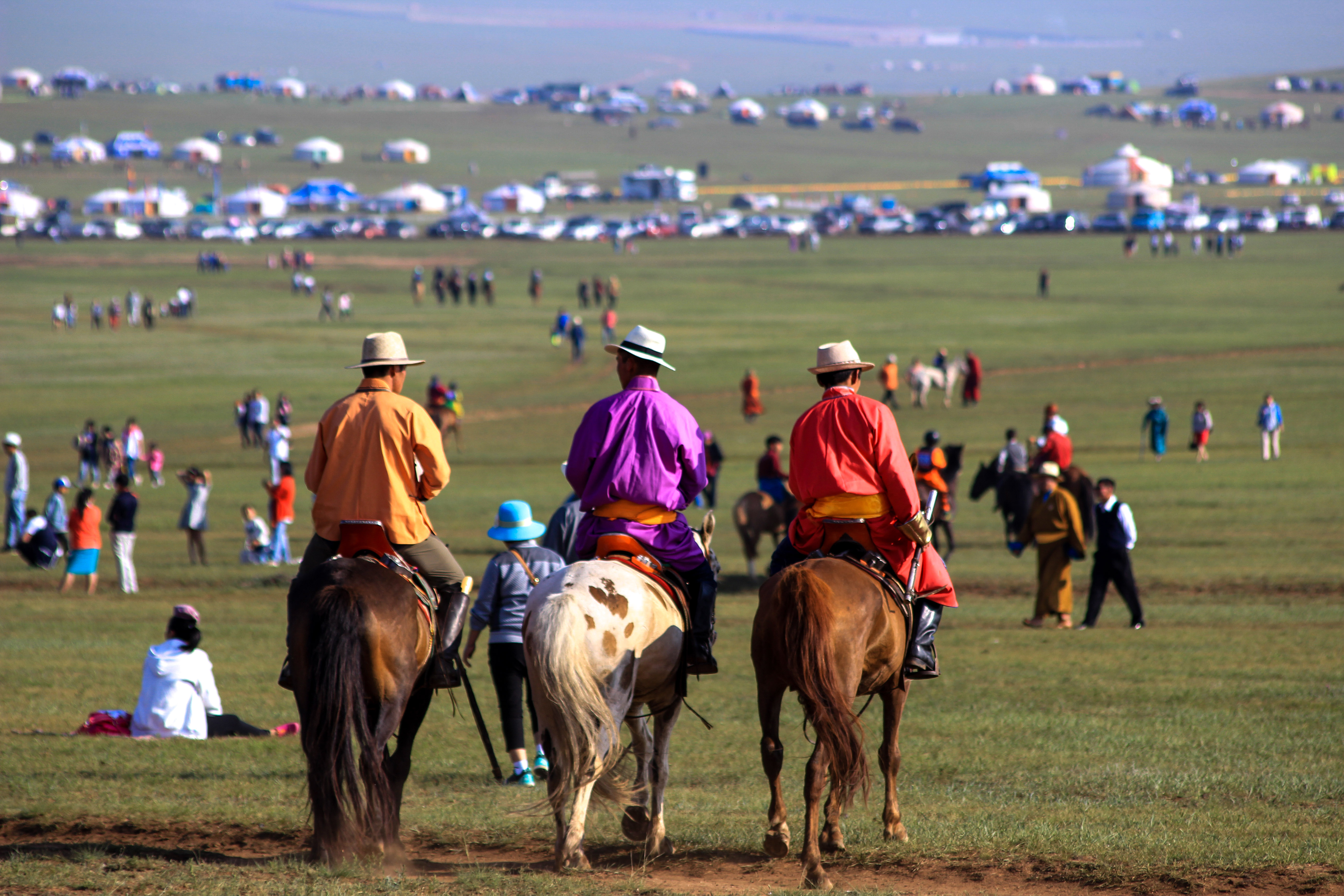
We attend the opening ceremony before watching competitors test their skill across the various events. Just as memorable as the sporting contests is the atmosphere surrounding them. Families travel from across the country to attend, many wearing traditional deel robes, while the festival grounds fill with food stalls, games, traders and informal gatherings.
Our tour leader helps us navigate the celebrations and explain the traditions behind each competition, adding valuable context to an event that sits at the heart of Mongolian identity.
Day 14 Visit Gandan Monastery • Attend Naadam Horse Racing
This morning, we visit Gandan Monastery, the largest functioning Buddhist monastery in Mongolia and an important centre of religious learning. As we walk through the complex, we may see monks in prayer and visit the temple housing the 65ft (20m) gold-and-bronze statue of Migjid Janraisig, one of the country’s most significant religious monuments.
Later, we head to Khui Doloon Khudag, where the Naadam horse races take place. Unlike many international horse-racing events, these contests are held across open grasslands, with horses racing over long distances that reflect Mongolia’s nomadic heritage. The spectacle of hundreds of riders and spectators gathering on the steppe provides a fitting conclusion to our time at the festival.
Total drive time: two to three hours