Galapagos Escape - Solaris (Itinerary B)

Walk (and snorkel) with the animals of Genovesa, Santa Fe, San Cristóbal and more 

Galapagos Escape - Solaris (Itinerary B)

Let's Call You

Trip Fee

$ 6.300

Date

05 - 10 March 2026

Trip Information

With lumbering giant tortoises, playful sea lions and an aviary of swooping, squawking, soaring bird life, the Galapagos Islands is wildlife-watching heaven. For this five-day trip, it’s all aboard the Solaris, a first-class motor yacht, to cruise around the archipelago in the company of an expert naturalist. Along the way, we stop at a string of biologically diverse islands, including Genovesa, Santa Fe and San Cristóbal, with the chance to get out and explore on foot and by snorkelling. Expect moments worthy of a nature documentary and plenty of photo opportunities.

Activity Areas

Birdwatching
Marine Wildlife
Wildlife Holidays

Region & Country & City

South America: Ecuador, Galapagos Islands Holidays

Included in the Price


- All breakfasts, four lunches, four dinners
- All accommodation
- All transport and listed activities
- Tour leader throughout
- Arrival transfers
- Snorkel equipment (mask, snorkel and fins) available free of charge on board
- All Accommodation: 5 Superior night (1 hotel, 4 first-class motor yacht)
- All breakfasts, four lunches, four dinners
- Immersive itinerary with all transport and listed activities
- Expert tour leader to enhance your adventure
- Arrival transfers
- Snorkel equipment (mask, snorkel and fins) available free of charge on board

Not Included In The Price

Request a single room if required, purchase travel insurance and arrange any visas and vaccinations. On this trip, compulsory Galapagos taxes US$220 is paid locally.

Accommodation Information


- Accommodation: 5 Superior night (1 hotel, 4 first-class motor yacht)
- Travel by internal flight, first-class motor yacht and minibus
- Group normally 2 to 16, plus leader. Minimum age: 12

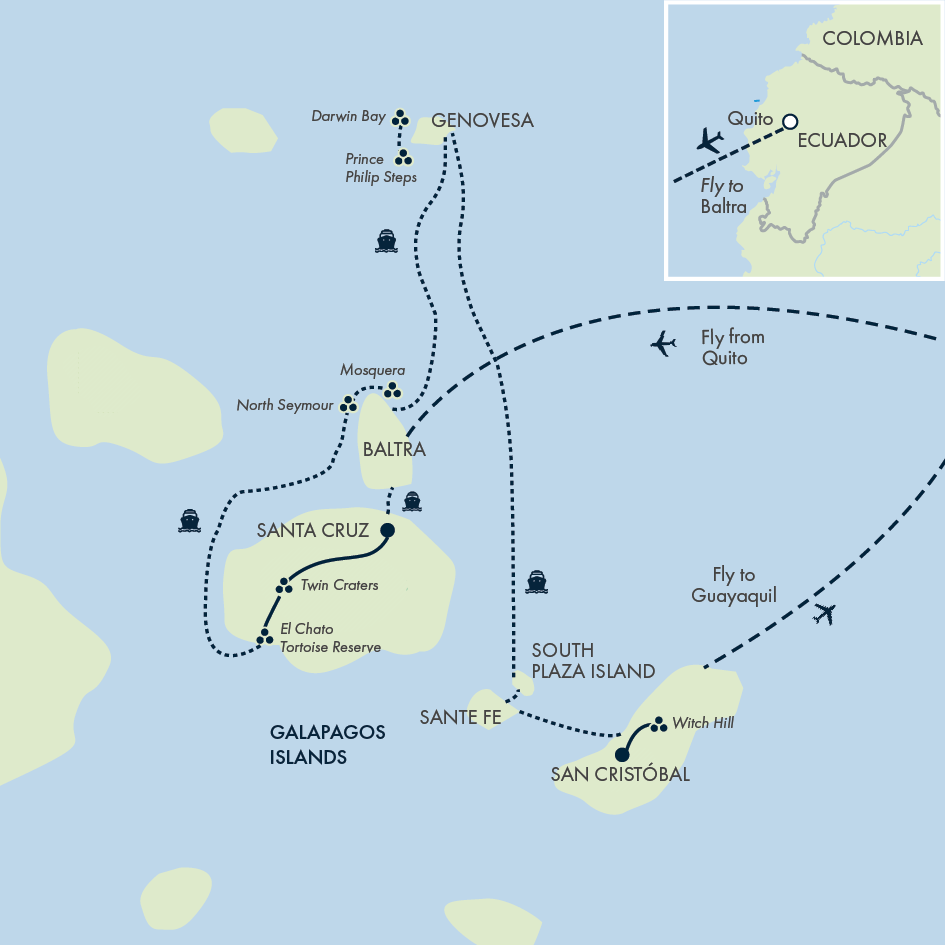
Map

Itinerary

Day 1 Start Quito

There are free transfers available for all clients today – make sure to check the Joining Instructions for further details. A local guide will welcome you to Quito and explain the schedule for the next few days. Upgrade to a suite today – speak to your sales representative for more details

Day 2 Fly to Baltra Airport on the Galapagos and Santa Cruz highlands

Morning flight to Galapagos You take a transfer to Quito Airport this morning and fly to Baltra Airport in the Galapagos Islands. Upon arrival, pass through the airport inspection point to make sure no foreign plant or animals are introduced to the island and to pay the national park entrance fee. Your guide will meet you, help you collect your luggage and escort you on a short bus ride to the harbour where a dinghy waits to take you to the yacht. Afternoon: El Chato Tortoise Reserve and Twin Craters (Santa Cruz) The native scalesia forest of El Chato Tortoise Reserve is the best place to search for Galapagos giant tortoises in their most authentic setting. Despite the interesting breeding centres – where you are guaranteed to find tortoises in their corrals – there is nothing better than to observe them in their wild environment. Though it can be quite moist and muddy, your visit may turn into an adventurous quest. The Twin Craters are found on either side of the road leading to Puerto Ayora. These impressive formations are not volcanic craters but were formed by magma domes, which hardened on the outside while the lava continued flowing inside, leaving huge and empty magma chambers that eventually collapsed, leaving two large holes. The craters lie within a lush scalesia cloud forest, a high-altitude plant species endemic to the Galapagos. This area is also home to the carpenter finch, which uses tools to search for food. You may also see the vermilion flycatcher, a small, red-breasted bird. Note: Breakfast is boxed

Day 3 North Seymour and Mosquera

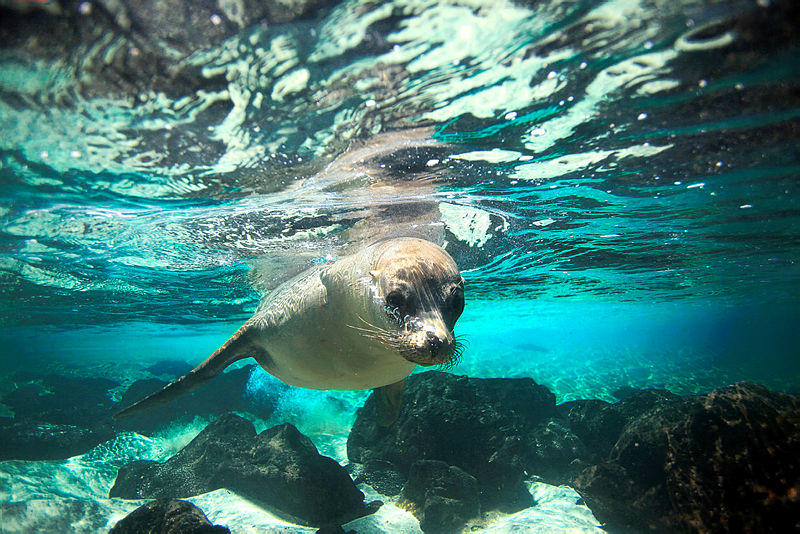
Morning: North Seymour North Seymour is an uplifted (as opposed to volcanic) island and therefore is generally flat and strewn with boulders. There are good nesting sites here for a large population of magnificent frigate birds. Blue-footed boobies perform their courtship dance in the more open areas and swallow-tailed gulls perch on the cliff edges. Despite the tremendous surf that can pound the outer shore, sea lions haul out onto the beach and can be found bodysurfing. Afternoon: Mosquera Galapagos sea lions are true beach lovers and Mosquera has coral white-sand beaches that contrast with the blue water to attract numerous sea lions. During a beach walk, you can observe several species of waders and sanderlings. Between the rocks, red clip crabs play hide and seek while you try to get the perfect photo. If you are lucky, you may even encounter yellow-crowned night herons or even a red-footed booby.

Day 4 Genovesa Island

Morning: Darwin Bay (Genovesa) Inside the submerged caldera of Genovesa lies Darwin Bay, with a diameter of more than 1mi (1.5km) and a depth of almost 650ft (200m). The small area will surprise you repeatedly, as you walk along a coral-sand beach, crossing barren lava formations and creeks, passing tidal pools, shrubs and following the cliff tops. With these peaceful surroundings, every species occupies its ecological niche without disturbing others. Whimbrels and wandering tattlers forage actively along the surf, next to resting Galapagos sea lions. Impressive frigatebirds and red-footed boobies nest in the mangroves, where you can also see vocalists such as the yellow warbler, Darwin’s finches and the Galapagos mockingbird. Uniquely, two subpopulations of the same species of large cactus finch differ in their singing. Afternoon: Prince Phillip’s Steps (Genovesa) Before landing, you take a dinghy ride along the eastern arm of the caldera with a chance to admire the 80ft (25m) high walls. Sometimes, a Galapagos fur seal is resting or a seabird is nesting on one of the ledges at the base. You then have to hike and overcome the steep stairs from the landing dock to a bush of palo santo shrubs on top. Red-footed boobies use these scarce nesting places, so they don’t have to nest on the rocky ground. Upon arriving at the edge of the rim, the bushes open up and you can enjoy panoramic views, a strong sea breeze and the amazing flying skills of countless seabirds. Following the exposed rim, you first pass nazca boobies and finally reach the extensive storm petrel nesting places, where, if you’re lucky, you can spot the well-camouflaged short-eared owl hunting for food.

Day 5 South Plaza and Santa Fe

Morning: South Plaza Enjoy an unforgettable guided walk on South Plaza, the best place to encounter endemic Galapagos land iguanas – patient and photogenic models. You can also look for some of the unique hybrids between the male marine iguanas and female land iguanas. Arriving at the upper rim, you’re 75ft (20m) above the waves splashing against the foot of the cliffs. Clouds of petrels, storm petrels, shearwaters and brown noddies make spectacular flights and sometimes look like they’re walking on the waves. Take your binoculars and don’t miss the red-billed tropicbirds with their graceful long tails and spectacular mating fights. These cliffs are also a nesting place for the endemic swallow-tailed gull. Afternoon: Santa Fe In the southeastern part of the Galapagos, this island was formed from an uplift instead of a volcanic origin, which is why it is mostly flat. Some say this could be the oldest island in the archipelago. Santa Fe is the home of several endemic species, including the Galapagos hawk, Galapagos snake, Galapagos mockingbird, rice rats, and one of the two species of land iguanas on the islands. After disembarking in the beautiful, clear waters, you will be in contact with one of the many sea lion colonies here. Along the trail, many salt bushes can be seen as well as giant prickly pear cacti; gigantism is a characteristic of oceanic islands. Although there is little vegetation on Santa Fe, it has two breath-taking beaches inhabited by sea turtles. At the foot of the mountain, you can also discover a small colony of Galapagos penguins.

Day 6 Disembark San Cristobal; fly to Guayaquil and end

Morning: Witch Hill (San Cristobal) Witch Hill is the remains of a tuff cone and one of the first sites visited by Charles Darwin. It has an impressive landscape, where it is often possible to see coastal and migratory birds, including pelicans, blue-footed boobies and swallow-tailed gulls, plus sea lions and marine iguanas. At times, the lagoon is completely dry and salt deposits lie at the bottom. The people of Puerto Baquerizo Moreno used to use the lagoon as a salt mine. Afternoon transfer to San Cristobal Airport Assisted by the naturalist guide and some crew members, the dinghy will bring you and your luggage to San Cristobal, where we take the airport shuttle. From here, we fly to Guayaquil where it's possible to connect with international flights this evening from 6pm onwards.

Travel Dates

05 - 10 March 2026 $ 6.300

15 - 20 March 2026 $ 6.300

19 - 24 March 2026 $ 6.300

29 March - 03 April 2026 $ 6.300

02 - 07 April 2026 $ 6.300

12 - 17 April 2026 $ 6.300

16 - 21 April 2026 $ 6.300

26 April - 01 May 2026 $ 6.300

30 April - 05 May 2026 $ 6.300

10 - 15 May 2026 $ 6.300

14 - 19 May 2026 $ 6.300

24 - 29 May 2026 $ 6.300

28 May - 02 June 2026 $ 6.300

07 - 12 June 2026 $ 6.300

11 - 16 June 2026 $ 6.300

21 - 26 June 2026 $ 6.300

25 - 30 June 2026 $ 6.300

05 - 10 July 2026 $ 6.300

09 - 14 July 2026 $ 6.300

19 - 24 July 2026 $ 6.450

23 - 28 July 2026 $ 6.300

02 - 07 August 2026 $ 6.450

06 - 11 August 2026 $ 6.300

16 - 21 August 2026 $ 6.300

20 - 25 August 2026 $ 6.300

30 August - 04 September 2026 $ 6.450

03 - 08 September 2026 $ 5.335

13 - 18 September 2026 $ 6.300

17 - 22 September 2026 $ 6.300

27 September - 02 October 2026 $ 6.300

01 - 06 October 2026 $ 6.300

11 - 16 October 2026 $ 6.300

15 - 20 October 2026 $ 6.300

25 - 30 October 2026 $ 6.300

29 October - 03 November 2026 $ 6.300

08 - 13 November 2026 $ 6.300

12 - 17 November 2026 $ 6.300

22 - 27 November 2026 $ 6.300

26 November - 01 December 2026 $ 6.300

06 - 11 December 2026 $ 6.300

10 - 15 December 2026 $ 6.300

20 - 25 December 2026 $ 6.300

03 - 08 January 2027 $ 6.600

07 - 12 January 2027 $ 6.600

17 - 22 January 2027 $ 6.600

23 - 28 January 2027 $ 6.600

31 January - 05 February 2027 $ 6.600

04 - 09 February 2027 $ 6.600

14 - 19 February 2027 $ 6.600

18 - 23 February 2027 $ 6.600

28 February - 05 March 2027 $ 6.600

04 - 09 March 2027 $ 6.600

14 - 19 March 2027 $ 6.600

18 - 23 March 2027 $ 6.600

28 March - 02 April 2027 $ 6.600

01 - 06 April 2027 $ 6.600

11 - 16 April 2027 $ 6.600

15 - 20 April 2027 $ 6.600

25 - 30 April 2027 $ 6.600

29 April - 04 May 2027 $ 6.600

09 - 14 May 2027 $ 6.600

13 - 18 May 2027 $ 6.600

23 - 28 May 2027 $ 6.600

27 May - 01 June 2027 $ 6.600

06 - 11 June 2027 $ 6.600

10 - 15 June 2027 $ 6.600

04 - 09 July 2027 $ 6.600

08 - 13 July 2027 $ 6.600

18 - 23 July 2027 $ 6.600

22 - 27 July 2027 $ 6.600

01 - 06 August 2027 $ 6.600

05 - 10 August 2027 $ 6.600

15 - 20 August 2027 $ 6.600

19 - 24 August 2027 $ 6.600

29 August - 03 September 2027 $ 6.600

02 - 07 September 2027 $ 6.600

12 - 17 September 2027 $ 6.600

16 - 21 September 2027 $ 6.600

26 September - 01 October 2027 $ 6.600

30 September - 05 October 2027 $ 6.600

10 - 15 October 2027 $ 6.600

14 - 19 October 2027 $ 6.600

25 - 30 October 2027 $ 6.600

28 October - 02 November 2027 $ 6.600

08 - 13 November 2027 $ 6.600

11 - 16 November 2027 $ 6.600

22 - 27 November 2027 $ 6.600

25 - 30 November 2027 $ 6.600

06 - 11 December 2027 $ 6.600

09 - 14 December 2027 $ 6.600

20 - 25 December 2027 $ 6.600

23 - 28 December 2027 $ 6.600
HIZLI ERİŞİM

FEST Travel ile Dünyayı Kültürüyle Keşfetmek için Üye Olun.


Bunu bir daha gösterme